Artificial intelligence has moved from a niche technology to an everyday companion. Writers use it to draft articles, designers to spark ideas, students to study, and businesses to scale faster than ever.
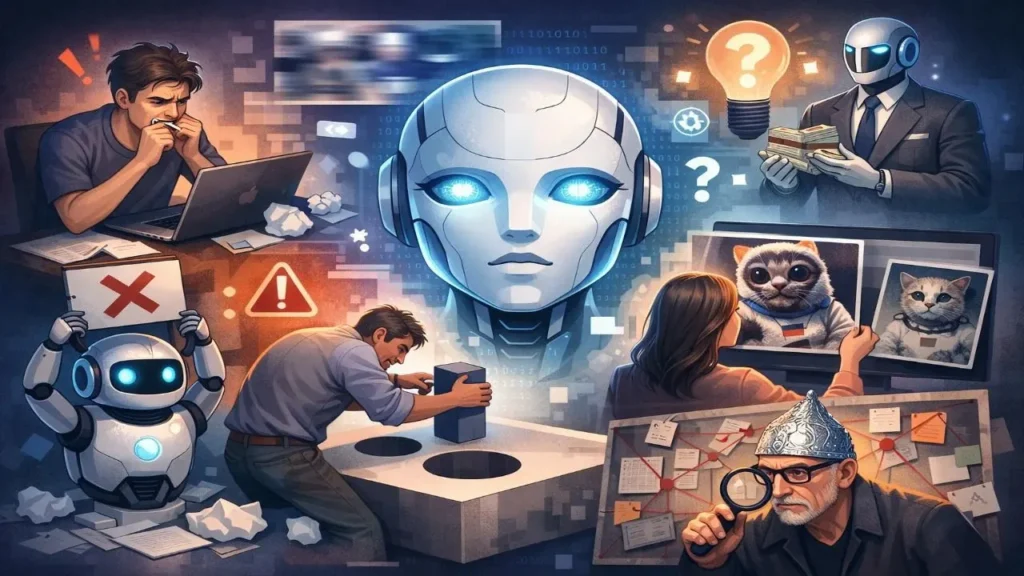
But as AI tools become easier to access, a pattern of costly mistakes is emerging not because the technology is flawed, but because of how people are using it.
Understanding these mistakes matters now more than ever. As AI reshapes work, learning, and creativity, the gap between smart users and careless users is growing fast.
Why This Matters Right Now
AI tools are no longer optional. They influence hiring decisions, search rankings, content visibility, and even trust.
People who misuse AI don’t just get poor results they risk falling behind, losing credibility, or making decisions based on flawed outputs.
The biggest danger isn’t that AI is replacing humans. It’s that humans are surrendering judgment too easily.
The Most Common AI Mistakes People Make
1) Treating AI Like an Authority, Not a Tool
One of the biggest errors is assuming AI is always correct. AI doesn’t “know” things it predicts responses based on patterns. When users stop questioning outputs, mistakes slip through unnoticed.
This is especially risky in:
- Research
- Health or finance topics
- Legal or business decisions
AI should support thinking, not replace it.
2) Using AI Without Clear Intent
Many people open an AI tool without a clear idea of what they want. They type vague prompts, get weak results, and then feel frustrated. Instead of questioning their input, they blame the tool.
AI can’t read minds it reflects the clarity you give it. When your direction is unclear, the output will be too.
AI performs best when users:
- Know the outcome they want
- Provide context
- Set boundaries
Without direction, AI becomes noise instead of value.
3) Copying Outputs Without Adding Human Insight
Another common mistake is publishing or submitting AI-generated content exactly as it appears. This creates content that feels empty, generic, and easily replaceable.
Audiences can sense when:
- No personal experience is added
- No opinion is taken
- No responsibility is owned
This doesn’t just hurt engagement, it weakens trust.
4) Ignoring Ethical and Legal Boundaries
Many users don’t consider who owns AI-generated content, how data is used, or whether outputs can legally be monetized.
This mistake often shows up later as:
- Copyright disputes
- Platform penalties
- Monetization restrictions
AI convenience can turn into a long-term risk if ethics are ignored.
5) Overusing AI for Tasks It’s Bad At
AI is excellent at summarizing, brainstorming, and organizing ideas. It’s far weaker at:
- Deep judgment
- Emotional nuance
- Context-heavy decisions
When people push AI into roles it wasn’t built for, quality collapses quietly.
The Hidden Cost of These Mistakes
The damage isn’t always immediate. It appears slowly:
- Declining originality
- Reduced credibility
- Overdependence on automation
- Loss of problem-solving skills
In professional settings, this can mean missed opportunities. In creative work, it can mean becoming invisible in a crowded space.
What Smart AI Users Do Differently
Experienced users treat AI as a thinking partner, not a shortcut. They:
- Cross-check important outputs
- Add lived experience and judgment
- Use AI to enhance, not replace, skill
- Stay informed about tool limitations
Most importantly, they remain accountable for the final result.
The Future Implication Most People Miss
As AI grows more powerful, human judgment becomes even more important. The future will favor people who think clearly, stay curious, and know when to trust AI and when not to.
Those who can guide AI with purpose, ask better questions, and take responsibility for the final decision will always stand out.
- Ask better questions
- Spot errors and bias
- Combine AI speed with human wisdom
Those who blindly rely on AI will compete on sameness. Those who guide AI with intent will stand out.
Final Take
The most common mistakes people make with AI tools aren’t about the technology itself they’re about mindset.
AI is not a replacement for thinking, creativity, or responsibility.
It simply multiplies whatever you bring to it. When used wisely, AI can sharpen your work and help you move faster. When used carelessly, it can slowly dull your edge. In the end, the real difference isn’t the tool, it’s the person using it.

Submit Your Tool
#1 Best and Most Affordable AI Tools DirectoryDevelopers and advertisers can share their AI tools on Openopediaai AI to reach a bigger audience. By listing your tool with us, you’ll get more visibility and help more people discover your product. You’ll also support the growth of the AI industry by making powerful tools easier for everyone to find and use!