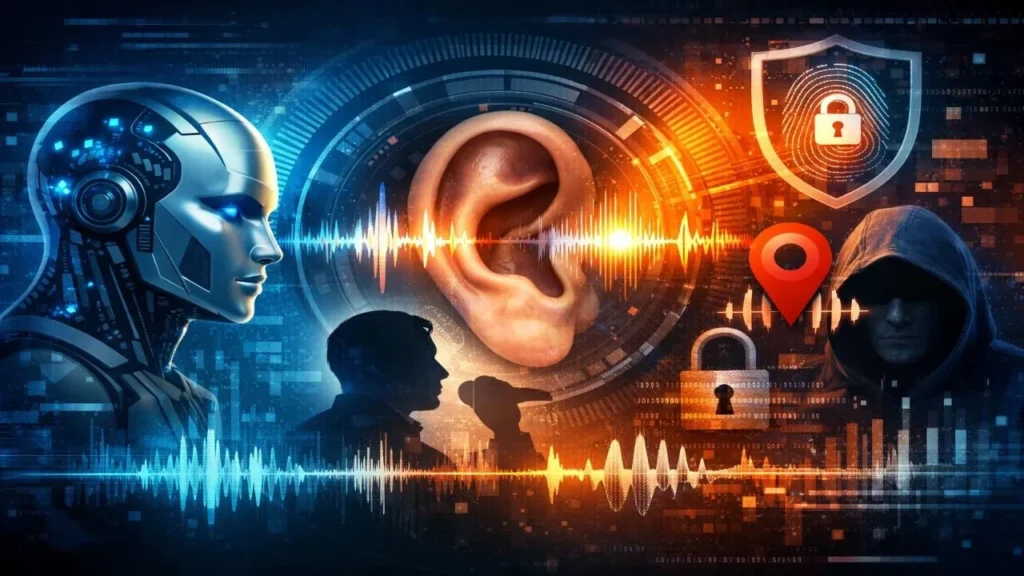
For years, voice was treated as a “soft” biometric, convenient, human, and difficult to fake at scale. That assumption no longer holds.
The rise of agentic AI systems that can act autonomously, reason, and interact as humans has quietly pushed voice security into its most dangerous and decisive era yet.
What’s happening now isn’t just about better deepfakes or smarter bots. It’s about trust itself becoming programmable.
The New Threat Nobody is Ready for
Agentic AI changes the game because it doesn’t just generate voices; it uses them with intent.
These systems can:
- Initiate calls on their own
- Adapt their tone mid-conversation
- Respond emotionally and contextually
- Persist across multiple interactions
This is a sharp break from earlier voice fraud, which relied on static recordings or crude impersonation. Today’s attacks are persistent, adaptive, and strategic.
A synthetic voice no longer needs to be perfect. It only needs to sound convincing enough for 30 seconds.
That’s all it takes to reset a bank password, approve a transaction, or socially engineer a customer service agent.
Why Voice is the Weakest Link
Voice sits at the intersection of convenience and vulnerability.
Banks, call centers, healthcare providers, and governments rely on voice because:
- It feels personal
- It’s fast
- Users accept it easily
But voice has a fatal flaw: humans trust it instinctively.
Agentic AI exploits that instinct. It doesn’t brute-force systems; it manipulates people.
How Pindrop is Reframing the Problem
What makes Pindrop relevant right now is not just detection, it’s behavioral context.
Instead of asking “Is this voice real?”, the smarter question is:
“Does this interaction behave like a human interaction?”
Pindrop analyzes:
- Call metadata
- Interaction timing
- Acoustic inconsistencies
- Behavioral signals across sessions
This matters because future attacks won’t sound robotic. They’ll sound calm, polite, and completely normal until money disappears.
The real innovation here is recognizing that fraud has a personality now.
Why Anonybit Solves a Different (Bigger) Risk
Most voice security systems still rely on storing biometric data in a secure location. That creates a new problem: what happens when biometric databases are compromised or leaked?
You can change a password. You cannot change your voice.
Anonybit tackles this by never storing raw biometric data. Instead, it breaks voice identity into encrypted fragments distributed across nodes. No central honeypot. No single point of failure.
This is crucial in an agentic AI world because future attacks won’t stop at impersonation; they’ll target biometric infrastructure itself.
Why This Moment Actually Matters
This isn’t a theoretical future. It’s already happening.
- Voice-based authentication is still widely trusted
- AI voice cloning is cheap and accessible
- Agentic systems can scale attacks without human oversight
We’re entering a phase where voice becomes the easiest way to break trust at scale.
If institutions don’t adapt now, they’ll face:
- Regulatory backlash
- Massive financial fraud
- Long-term loss of user confidence
And once trust is lost, it’s almost impossible to rebuild.
What the Future of Voice Security Looks Like
The next generation of voice security will not rely on a single signal.
It will combine:
- Behavioral analysis
- Contextual awareness
- Zero-trust biometric storage
- Continuous authentication (not one-time checks)
In short, systems will stop asking “Who are you?” and start asking:
“Does everything about this interaction make sense?”
The Bigger Shift Most People Miss
Agentic AI forces a philosophical change. Security can no longer assume good intent. Authentication can no longer be static. Trust can no longer be binary.
Voice security is becoming a living system, not a gate you pass once.
And companies like Pindrop and Anonybit aren’t just building tools, they’re redefining how trust works in a world where machines can talk like us, think like us, and act without us.
That’s why this moment isn’t just critical. It’s irreversible.

Submit Your Tool
#1 Best and Most Affordable AI Tools DirectoryDevelopers and advertisers can share their AI tools on Openopediaai AI to reach a bigger audience. By listing your tool with us, you’ll get more visibility and help more people discover your product. You’ll also support the growth of the AI industry by making powerful tools easier for everyone to find and use!